Finding Birds with your Binoculars
One thing that beginning birders can struggle with when starting, is just the point of getting the bird in their binoculars right away. This is a skill that with a bit of practice, can save you quite a bit of frustration and time.
The Spotting Technique
Many new birders try bringing their binoculars to their eyes and then looking for the bird. This strategy will often leave you failing to find the bird. Your field of view when looking through binoculars are much narrower than our typical field of view.
Binoculars not only block out most of the surrounding area, they make it harder to notice movement around you. It is much easier to make sure to get the bird in your binoculars right away, and not having to scan for it after you bring your binoculars up.
Instead of lifting the binoculars first, find the bird with your naked eye, lock your gaze on it, and then raise the binoculars smoothly to that same spot without moving your eyes or head.
The key is bringing your binoculars to your eyes without moving your line of sight off the bird. If you lift your head to meet your raised binoculars, you’ll have a hard time finding your bird right away. Practice, Practice, Practice, and you will successfully master this skill in no time.
That way, you’ll stay on target instead of scanning the trees in frustration. There’s nothing more frustrating than having a bird in your sights and not being able to then find it in your binoculars. This transition will become easier over time as you get more practice with your binoculars.
Scanning
The other technique you will use your binoculars for is called scanning. While typically you will be using the spotting method discussed, there are times when there may be birds out at a greater distance that you may not even notice with your naked eyes. A good example of this is if you are looking over a marsh, wetland, or field, and are looking for possible waterfowl, shorebirds, and grassland birds. A large open area where birds may be, but just at a distance that they are hard to immediately notice.
When you are scanning, pick a strategy.
Start at either the left or right of the area you plan on scanning, and break the area into sections. Maybe slowly scan from left to right, but in rows.
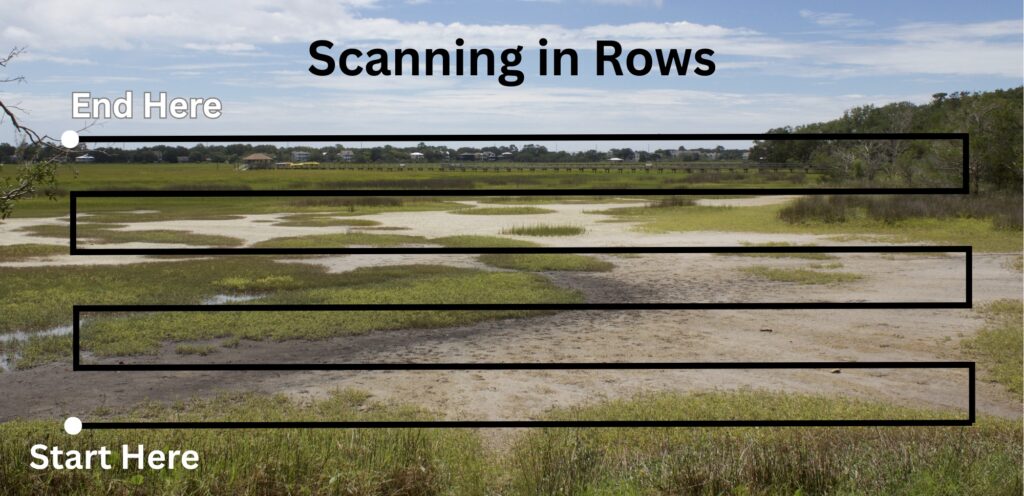
Start in a close row, scan, raise your viewing area to just behind that first row that you just scanned, and slowly scan in the opposite direction. Continue scanning and adjusting the section you are viewing until you get to the furthest point you can see with your binouclars.
Breaking an area up into sections or rows makes sure you are not missing any birds, and are thoroughly checking the entire area!