How Guides are Laid Out
So now you have a guide that contains all the species you may encounter on your outings, but how do you use it to find the species you see in the field?
So lets look at how these guides are organized.
Most field guides group birds by family in taxonomic order— so similar birds are placed together.
For example:
- Ducks → Geese → Swans
- Hawks → Eagles → Falcons
- Warblers → Sparrows → Finches
By placing similar species together, in a predictable order, field guides allow you to quickly narrow down your possibilities, making the ID process easier and less overwhelming
This taxonomic order is based off our current best understanding of how each species group evolved; with those that had split the earliest from a common ancestor of all birds to the more recent splits from that ancestor.
This understanding of how birds evolved has changed greatly since the very first field guide, and if you look through different books published since the first guides, you will notice that the order of birds has changed as we have developed a greater understanding of birds and their evolution.
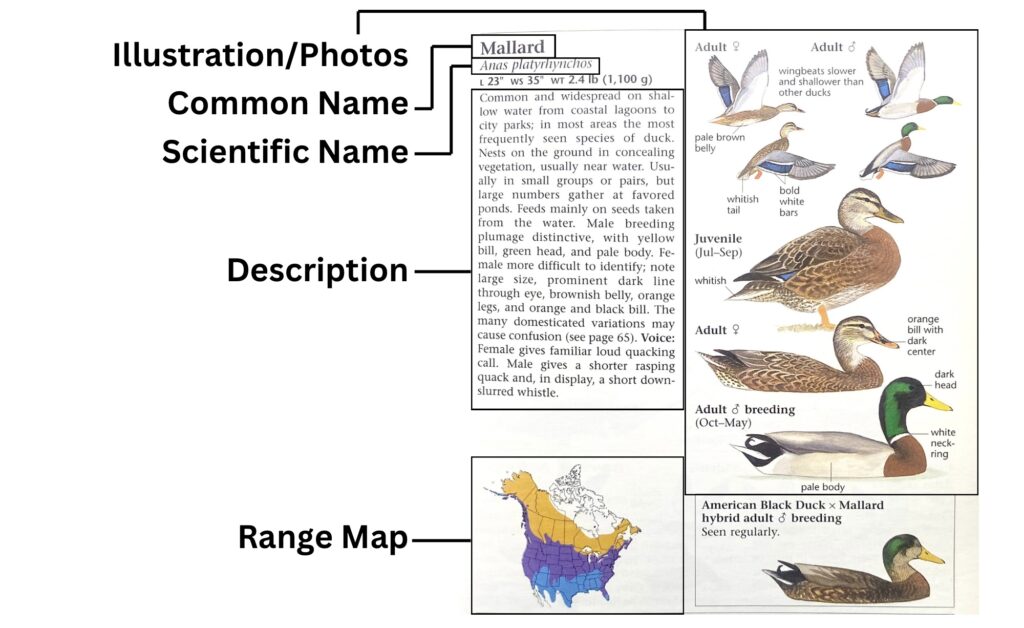
From there each species usually has:
- A common and scientific name, every bird has both, while most birders are more familiar with a bird’s common name, sometimes these get changed or vary from region to region. A scientific name is the same across the world. This name allows you to know for certain what a particular species is.
- Illustration or photo, these may be laid out next to their species profile or laid out on the opposite page all together, these collages of illustrations on one page are typically called plates. These illustrations or photos are your main key to piecing together clues to identify a bird. They are laid out in a way for you to easily compare field marks such as beak shape, facial markings, tail length or shape and wing bars for example
- Range map showing where and when it occurs. A range map is a small colored map that shows where the bird can be found and when — whether that is its breeding or wintering range, or its present year-round.
Range maps allow you to easily tell what are expected species in your area, while this is generally pretty accurate, it doesn’t exclude the odd individual that may show up in a weird area. For example, if your guide says a bird only spends its summers in Florida, but you’re in Maine in December, it’s most likely not your bird. - A short description of key ID features, voice, and Each bird entry also includes:
- Physical traits: size, shape, color pattern
- Notable Behaviors: flight style, feeding habits
- Voice: song or call description (“cheerily, cheer-up!” for robins)
- And Habitat: forest, marsh, backyard, etc.
These are the main keys found in a field guide, creating a handy reference for each species, making it easier for you to ID your bird quickly.