Styles of Guides
There are a few main styles of field guides — and choosing one is a little like finding the right pair of binoculars: it depends on your own personal style and goals.
When you browse bird books, you’ll find two main styles:
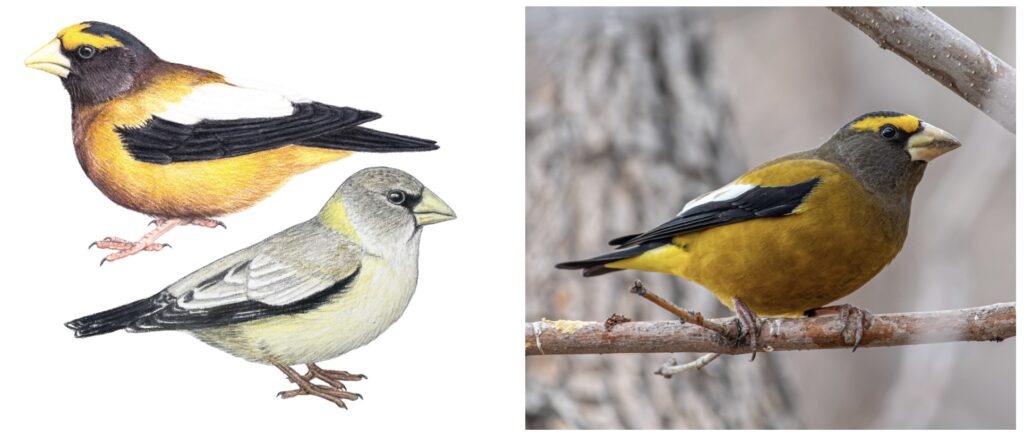
Illustrated Field Guides
One style consists of painted or drawn illustrations by artists who emphasize key identification features — things like wing bars, eye rings, or tail shape.
These ones are best for learning field marks, comparing similar species, and recognizing patterns.
Popular examples:
- The Sibley Guide to Birds (David Sibley)
- National Geographic Field Guide to the Birds of North America
The benefit of this style is that the art shows consistent poses and lighting, making subtle details easier to compare — even between very similar species. These illustrations are made to be a perfect example of the species and their field marks. A more generalized view of the species
Photographic Field Guides
Then their are guides that use real photos of birds, often taken in the wild.
Best for: Seeing what birds actually look like in real conditions and lighting.
Popular examples:
- Kaufman Field Guide to Birds of North America
- Audubon Bird Guide
The benefit of this style is that you see birds in lifelike poses and can match your own photos more easily.
If you’re just starting out, many birders find illustrated guides easier for learning field marks, while photo guides are great for quick confirmations, but it really just comes down to personal preference. And Some birders use both! As an artist myself, I greatly prefer using illustrated guides, where a bird pictured is presented as a representation of its species, showing off all of their field marks, not a picture which only demonstrates a single specific individual bird where details can be deceiving based on its angle, shadows and differences in feather wear.
I am not the only birder who prefers illustrated field guides, most birders I know use a sibley guide in one way or another.

Another option to consider when picking out a guide is how expansive the area you want the guide to cover. Did you want it to cover your whole country, like all of North America for example, or maybe just the eastern or western half of the country. These guides that have a narrower scope of the region they cover are often called Regional Guides. These guides can cover an entire country, parts of a country or even specific states.
Regional Guides can be a great help when you are first starting out as chances are if you are in the eastern half of North America for example, there will be many species present in a general guide that you don’t need to worry about learning to start with. While a Country wide guide can cover around 800 species, a regional guide may only show 300-500, excluding species you most likely won’t even encounter in your area, making the process of narrowing down the species you are seeing much less intimidating.
App vs physical book
Another thing to consider when picking out a guide is in what form do you prefer? Until recently, if you wanted a field guide with you in the field, you would need to bring a physical book with you, which in several instances may not be really ideal to use. But now with smart phones and apps, you can have a world of field guides and references at your fingertips and available in seconds. These apps can range from free, to paid for.
No matter what, I highly recommend you download the Merlin app, which will be gone over thoroughly later in this course. While it doesn’t go into much details on how to id the bird, it is very handy for a quick photographic reference guide and can be narrowed down to species that will only be found in your area during the exact time of year you are in a location, a very handy feature to have!
Other handy bird ID apps are the Audubon Bird Guide and Sibley Birds app, though this is an app you will have to pay for.
But really, both have their pros and cons and I myself have a combo of both physical and app field guides I regularly use. I also have both the Merlin app and Sibley’s app on my phone, each has their own use for different situations I encounter in the field. For a quick reference, whether that be visual or an unfamiliar sound, Merlin is best. But for a deep dive into ID characteristics, Sibley is my go to.
So my recommendation is to start with the Merlin App on your phone and one physical book, the Sibley’s bird guide, either the eastern or western version depending on where you live.